
You have done an AI visibility audit to check whether your business appears in AI search.
Now the next question is:
How do you improve it?
If your business is missing from ChatGPT, Google AI Overviews, Perplexity, Gemini, Copilot or other AI-driven search tools, it usually means the right signals are not strong enough yet.
That does not always mean your website is bad.
It may mean your content is unclear, your service pages are too thin, your brand information is inconsistent, your competitors have stronger trust signals, or AI search platforms do not yet have enough confidence to mention, cite or recommend your business.
Improving AI visibility is not about chasing tricks or trying to manipulate AI tools.
It is about making your business easier to find, understand, verify and trust.
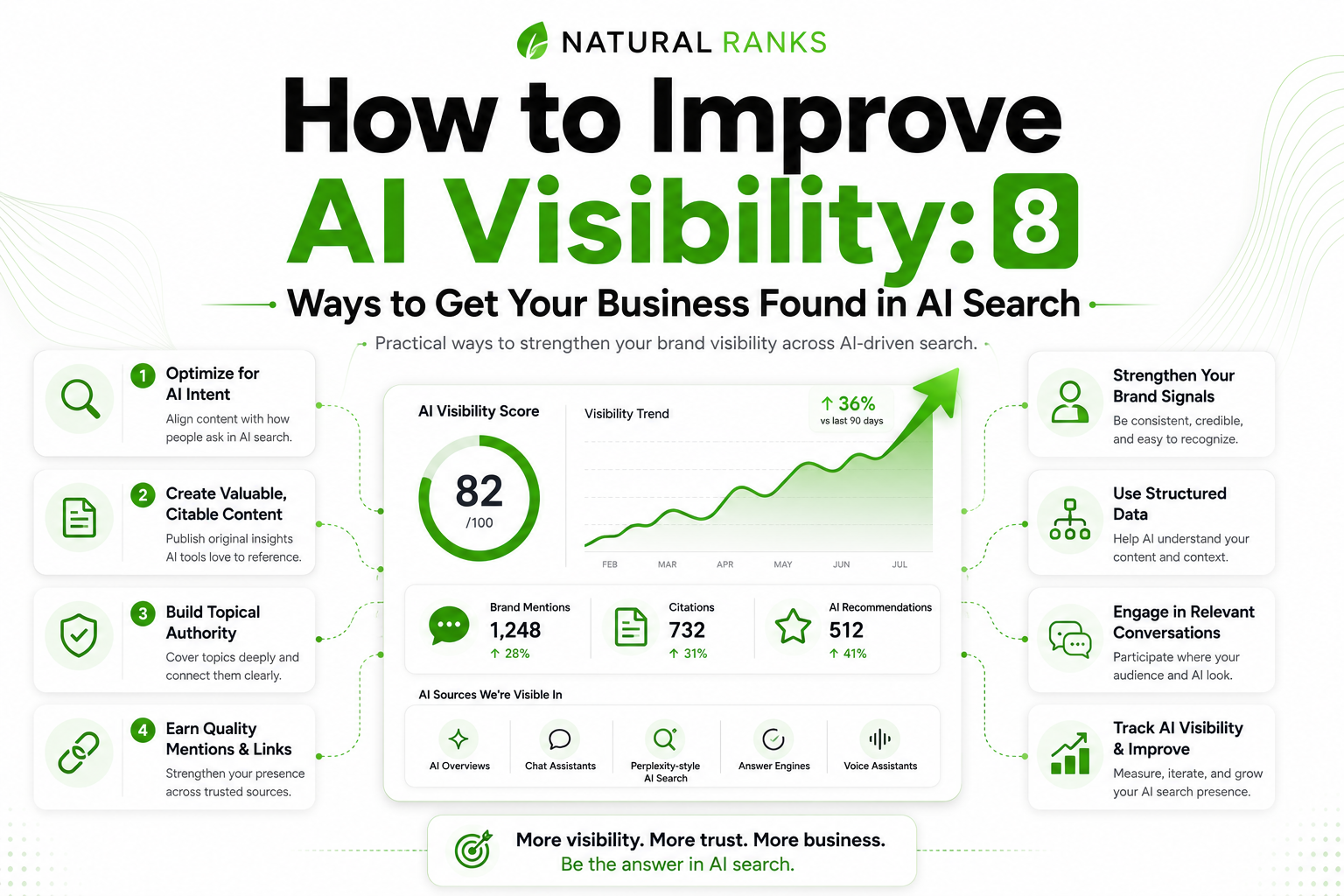
This guide covers eight practical ways to improve AI visibility and give your business a better chance of being found in AI-generated answers.
Start With What Your AI Visibility Audit Shows
Before making changes, look at what your audit has actually revealed.
The best improvements usually come from identifying patterns.
For example:
- Are competitors appearing where your business is missing?
- Are AI tools citing competitor websites instead of yours?
- Is your business mentioned, but described vaguely?
- Are your services misunderstood?
- Are outdated sources being used?
- Are third-party sites appearing more often than your own website?
- Are you visible for branded searches but missing from non-branded recommendations?
These answers should guide your priorities.
If AI tools cannot find your content, the issue may be technical.
If they find your website but do not understand your services, the issue may be page clarity.
If competitors are being recommended instead, the issue may be authority, reviews, content depth or third-party trust signals.
The aim is to fix the weakest signals first.
1. Fix Technical Barriers That Stop AI Tools Finding Your Content
AI visibility starts with discoverability.
If search engines and AI-powered search systems cannot crawl, render or index your important pages properly, your content is less likely to be used.
That is why technical SEO still matters.
A technical review should check:
- whether important pages are indexed
- whether key pages are blocked by robots.txt
- whether pages have incorrect canonical tags
- whether internal links point to priority pages
- whether there are broken links
- whether important content loads properly
- whether JavaScript is hiding key information
- whether the XML sitemap is clean and up to date
- whether duplicate or thin pages are causing confusion
- whether page speed or mobile usability is poor
Technical issues can quietly weaken visibility.
For example, a business may have a strong service page, but if that page is not indexed or is buried too deeply within the site, it may not be treated as important.
AI visibility is not only about creating more content.
It starts with making sure your existing content can actually be found and understood.
2. Make Your Service Pages Clearer and More Specific
Your service pages should make it obvious what you do, who you help and why your business is relevant.
Vague service pages are a problem.
They make it harder for users to understand your offer, and they make it harder for search engines and AI tools to connect your business with the right queries.
For example, this is too broad:
I help businesses grow online.
This is much clearer:
I help service-led businesses improve organic visibility through technical SEO audits, content strategy, AEO, GEO and search-focused website improvements.
The second version gives more context. It explains the audience, the service areas and the type of work involved.
A strong service page should answer:
- what the service is
- who the service is for
- what problem it solves
- what is included
- how the process works
- what makes you qualified
- what outcomes matter
- what the visitor should do next
AI systems need clarity.
If your website is vague, your business becomes harder to classify, summarise and recommend.
The more specific your service pages are, the easier it becomes for AI-driven search tools to understand where your business fits.
3. Add Answer-Led Sections to Commercial Pages
Blog content is useful, but your commercial pages also need to answer questions.
People often ask AI tools decision-making questions before they enquire.
For example:
- How much does this cost?
- Is this right for my business?
- What is included?
- How long does it take?
- What should I look for?
- What are the risks?
- What makes one provider different from another?
- Do I need this if I already have SEO?
These are buying-stage questions.
They come from users who may already be considering a service or comparing providers.
Your service pages should answer these questions directly.
That could mean adding:
- short FAQ sections
- process sections
- pricing guidance
- comparison blocks
- “who this is for” sections
- “common problems” sections
- “what’s included” sections
- “why this matters” sections
This helps users, but it also gives AI search platforms clearer information to work with.
The aim is not to overload every page.
The aim is to make your most important commercial pages more useful, more complete and easier to interpret.
4. Build Supporting Topic Clusters
One page is rarely enough to build strong visibility around a topic.
If you want your business to be associated with a service, subject or problem, your website needs supporting content around it.
That is where topic clusters help.
A topic cluster is a group of connected pages that cover different parts of the same subject.
For example, if you want to be more visible for AI search and AEO/GEO-related services, your content cluster could include:
- AEO vs SEO vs GEO
- AI visibility audit
- how to improve AI visibility
- how to get mentioned in ChatGPT
- how to appear in Google AI Overviews
- how AI search changes the customer journey
- how to measure AI search visibility
- how to optimise service pages for AI search
Each page answers a different question.
Together, they show depth.
Internal linking is important here.
Your supporting articles should link back to the main service pages, and your service pages should link to the most useful supporting guides.
This helps users move through your site.
It also helps search engines and AI systems understand the relationship between your services, content and expertise.
5. Publish Content Worth Citing
AI tools need sources.
If your content is thin, generic or similar to everything else online, there is little reason for it to be used, cited or referenced.
To improve AI visibility, your content needs to be genuinely useful.
That means publishing content with:
- clear explanations
- original insight
- practical examples
- expert commentary
- first-hand experience
- useful comparisons
- specific recommendations
- evidence of judgement
- answers to real customer questions
Generic content is easy to ignore.
Useful content is harder to ignore.
For example, a basic article called:
What is SEO?
may be too broad to stand out.
A stronger, more useful article might be:
Why Your SEO Is Not Generating Enquiries Even Though Rankings Have Improved
That type of content shows practical understanding.
The same applies to AI search.
Instead of only publishing broad definitions, create content that helps people make decisions, diagnose problems or understand what to do next.
AI visibility improves when your content becomes a useful source, not just another page.
6. Use Structured Data to Reinforce Page Meaning
Structured data helps search engines understand your content more clearly.
It adds extra context to a page, helping define things such as articles, FAQs, organisations, people, services, reviews and local business information.
Structured data will not make weak content perform.
But it can support strong content by making the meaning of the page clearer.
Useful schema types may include:
- Article schema
- FAQ schema
- Organisation schema
- Person schema
- LocalBusiness schema
- Service schema
- Review schema where appropriate
For example, if you publish a guide, Article schema helps define it as an article.
If you add visible FAQs, FAQ schema can reinforce the questions and answers.
If you have a strong About page and author profile, Person and Organisation schema can help clarify who is behind the content.
The important rule is simple:
Structured data should match what users can see on the page.
Do not add schema for things that are not visible, accurate or relevant.
Schema should reinforce clarity, not create a false layer of information.
7. Strengthen Reviews, Proof and Trust Signals
AI visibility is not only influenced by your website.
Your wider online presence also matters.
If AI search platforms are trying to decide which businesses are credible, they may look for signals beyond your own service pages.
Useful trust signals include:
- client reviews
- testimonials
- case studies
- examples of work
- clear author profiles
- clear contact details
- third-party mentions
- relevant directory listings
- industry articles
- awards or accreditations
- social proof
- consistent business profiles
For service-led businesses, trust is especially important.
Customers are often choosing between multiple providers. They want proof that you know what you are doing.
If competitors have stronger reviews, clearer case studies, more third-party mentions and more complete business profiles, they may have an advantage.
Improving trust signals helps users make decisions.
It also gives search engines and AI tools more confidence in your business.
8. Make Your Brand Information Consistent Across the Web
AI tools need to understand your business as an entity.
That means your business information should be consistent wherever it appears.
Check your details across:
- your website
- Google Business Profile
- review platforms
- industry directories
- local citations
- author profiles
- guest articles
- business listings
Look for inconsistencies in:
- business name
- address
- phone number
- service descriptions
- locations served
- founder or author details
- old services
- outdated positioning
- duplicate profiles
Inconsistent information can create confusion.
For example, if your website says you specialise in SEO consultancy, but your profiles elsewhere describe you mainly as a web designer, AI tools may not clearly understand your main positioning.
Brand consistency helps reinforce who you are, what you do and why you are relevant.
The clearer and more consistent your digital footprint is, the easier your business becomes to understand.
Track Whether Your AI Visibility Is Improving
Once you make improvements, you need to track whether they are working.
AI visibility is not always as easy to measure as traditional rankings, but you can still monitor patterns over time.
Track three key signals.
Mentions
Is your business being named in AI-generated answers?
Citations
Is your website being used as a source?
Recommendations
Is your business being suggested when users ask for providers, experts or solutions?
A simple way to start is by testing a fixed set of prompts each month across platforms such as ChatGPT, Google AI Overviews, Perplexity, Gemini and Copilot.
Track whether:
- your business appears more often
- competitors appear less often
- your website is cited more frequently
- your business is described accurately
- your services are understood clearly
- visibility improves across non-branded prompts
This turns AI visibility from guesswork into something you can review and improve.
How to Prioritise AI Visibility Improvements
Not every business needs to do everything at once.
Start with the issues most likely to be holding visibility back.
If important pages are not indexed, fix technical SEO first.
If your service pages are vague, improve page clarity first.
If competitors have stronger content, build better supporting guides.
If competitors are being cited from third-party sources, improve reviews, profiles and external mentions.
If AI tools describe your business incorrectly, fix brand consistency and strengthen your About, service and profile pages.
A simple priority order is:
- Make sure important pages can be found.
- Make sure service pages are clear.
- Answer the questions customers actually ask.
- Build supporting content around key topics.
- Strengthen proof, reviews and trust signals.
- Improve brand consistency across the web.
- Monitor whether visibility improves.
This keeps the process practical.
You do not need to chase every AI search trend.
You need to improve the signals that make your business easier to understand and trust.
AI Visibility Improvement Checklist
Work through each question below. The more "No" answers you have, the greater the opportunity to improve your AI visibility.
Final Thoughts
Improving AI visibility is not about chasing hacks.
It is about strengthening the signals that help AI search platforms find, understand, trust and recommend your business.
That means better technical foundations, clearer service pages, useful content, stronger topical authority, structured data, trust signals and consistent brand information.
The businesses that benefit most from AI search will not necessarily be the ones shouting the loudest.
They will be the ones that are easiest to understand, easiest to verify and easiest to recommend.
In simple terms:
More visibility. More trust. More business.
Need Help Improving Your AI Visibility?
Not sure whether your business is being found, cited or recommended in AI search?
Request an AI Visibility Review