
In this guide:
- What Is SEO?
- What Is AEO?
- What Is GEO?
- SEO vs AEO vs GEO: The Simple Difference
- Why These Terms Are Becoming More Important
- The Biggest Misunderstanding About AEO and GEO
- How Search Behaviour Has Changed
- How SEO, AEO and GEO Work Together
- What Businesses Should Do Now
- How to Optimise for SEO
- How to Optimise for AEO
- How to Optimise for GEO
- Final Thoughts
Search is changing quickly.
For years, most businesses have focused on SEO: getting their website found in Google when someone searches for a product, service or answer. That still matters. In fact, it still forms the foundation of online visibility.
But the way people search is evolving.
Today, users are not only typing keywords into Google. They are asking direct questions. They are using AI tools such as ChatGPT, Gemini, Copilot and Perplexity. They are seeing AI Overviews in Google. They are expecting quick answers, summaries, comparisons and recommendations without always clicking through multiple websites.
That shift has introduced two newer terms into the search marketing conversation: AEO and GEO.
AEO stands for Answer Engine Optimisation.
GEO stands for Generative Engine Optimisation.
Both are closely connected to SEO, but they are not exactly the same thing. Understanding the difference matters because businesses now need to think beyond traditional rankings. It is no longer just about being number one in Google. It is also about being visible, trusted and referenced when search engines and AI platforms generate answers.
Google’s own guidance makes an important point: SEO best practices still apply to generative AI search experiences, because Google’s AI features are rooted in its core search ranking and quality systems. Google also acknowledges that AEO and GEO are terms used to describe visibility work for AI search experiences, while stating that, from Google Search’s perspective, this is still part of SEO.
So, is SEO dead?
No.
But SEO is expanding.
This article explains the difference between SEO, AEO and GEO, how they overlap, and what businesses should be doing now to stay visible as search continues to change.
What is SEO?
SEO stands for Search Engine Optimisation.
It is the process of improving a website so it can be found, crawled, understood and ranked by search engines such as Google and Bing.
Traditional SEO focuses on increasing visibility in organic search results. These are the unpaid listings that appear when someone searches for something relevant to your business.
For example, if someone searches:
“SEO consultant in Lancashire”
“mobility scooters on finance”
“septic tank cleaning near me”
“commercial property solicitor London”
SEO is what helps the most relevant websites appear in those search results.
Google’s own SEO Starter Guide describes SEO as improving a site’s presence in Search, with best practices that help search engines crawl, index and understand content.
At its core, SEO is about three things:
1.Making your website technically accessible.
2.Creating useful, relevant content.
3.Building enough trust and authority for search engines to choose your site over competitors.
SEO includes a wide range of work, such as keyword research, technical SEO, content optimisation, internal linking, page speed, structured data, local SEO, link building, user experience and ongoing performance analysis.
The aim is simple: help your website appear when potential customers are searching for what you offer.
What is AEO?
AEO stands for Answer Engine Optimisation.
It is the process of optimising your content so it can be used to answer specific questions directly.
AEO became more important as Google introduced features such as featured snippets, People Also Ask boxes, knowledge panels and voice search results. These search features changed the way users interacted with search engines.
Instead of only showing a list of blue links, Google started giving direct answers.
For example, someone might search:
“What is AEO?”
“How much does SEO cost?”
“What is the difference between SEO and GEO?”
“Do I need structured data for AI search?”
An answer engine tries to give the user a clear response quickly. AEO is about structuring your content so that your answer is easy to find, understand and extract.
AEO is not just about ranking a page. It is about becoming the answer.
That means clear headings, direct explanations, concise definitions, FAQ sections, schema markup, strong topical relevance and content that answers the user’s question without making them work too hard.
AEO is especially useful for informational searches, comparison searches and question-led searches.
If SEO is about helping a page rank, AEO is about helping a specific answer get selected.
What is GEO?
GEO stands for Generative Engine Optimisation.
It refers to the process of improving your brand, website and content visibility within generative AI search platforms and AI-generated answers.
These platforms include tools and search experiences such as:
ChatGPT with search
Google AI Overviews and AI Mode
Microsoft Copilot
Perplexity
Gemini
Other AI assistants and answer platforms
OpenAI describes ChatGPT search as a way to get timely answers with links to relevant web sources, blending a natural language interface with up-to-date information from the web. Google describes AI Overviews as AI-generated snapshots that provide key information and links to dig deeper.
GEO is about making your content more likely to be discovered, understood, trusted and referenced by these AI systems.
This does not mean “tricking” AI tools into mentioning your brand.
It means creating content and online signals that are clear, authoritative, well-structured and useful enough to be considered when an AI system is forming an answer.
GEO can include:
Clear expert-led content
Strong brand authority
Original insight and experience
Well-structured service pages
Helpful guides and comparison content
Consistent entity information across the web
Good technical SEO
Structured data
Mentions from trusted third-party sources
Content that answers natural language questions
Unlike traditional SEO, where the aim may be to rank in a list of search results, GEO is more focused on being cited, summarised, recommended or included in an AI-generated response.
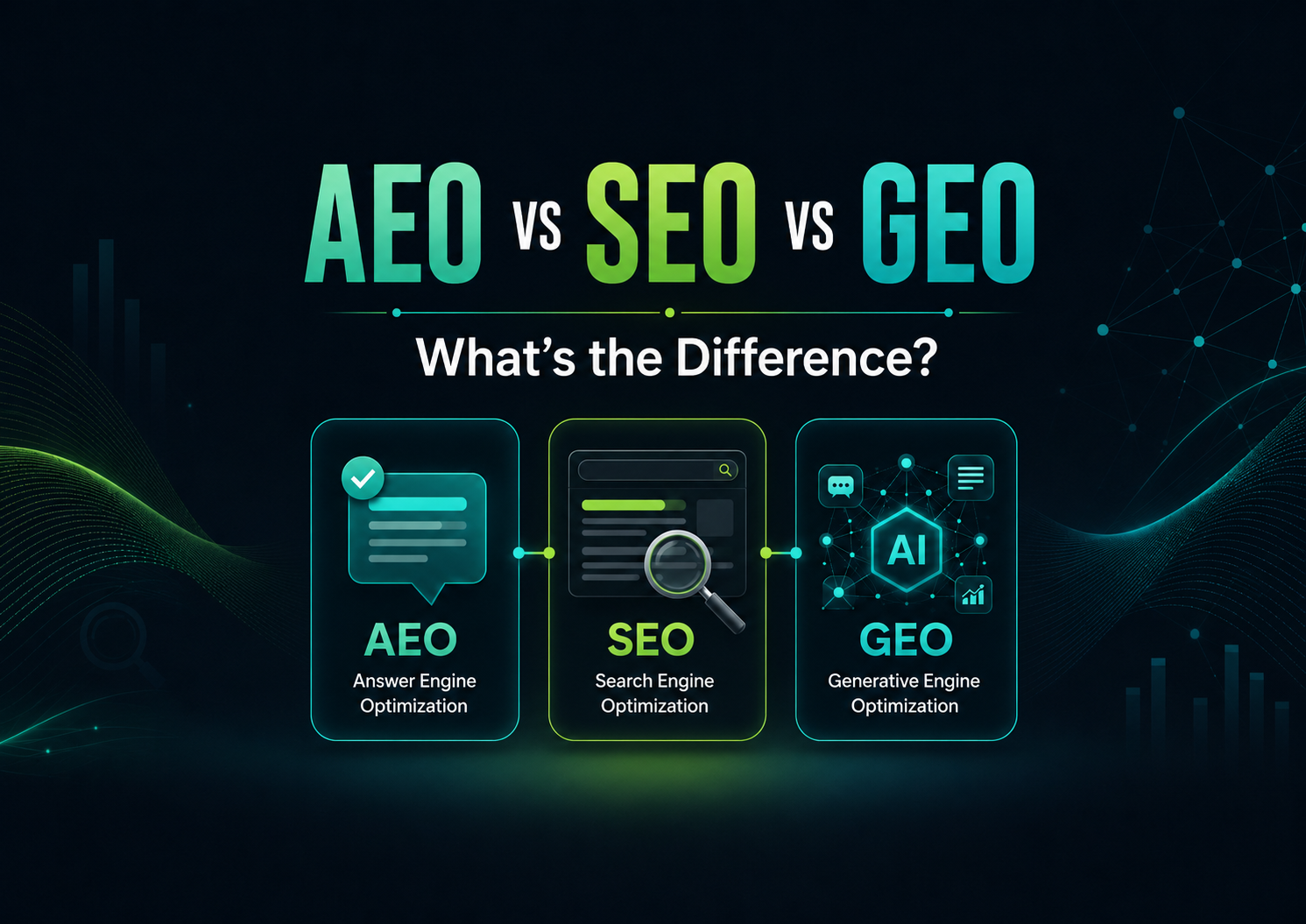
SEO vs AEO vs GEO: The Simple Difference
The easiest way to understand the difference is this:
SEO helps your website rank in search results.
AEO helps your content answer specific questions.
GEO helps your brand and content appear in AI-generated answers.
They are separate ideas, but they overlap heavily.
You cannot do GEO properly if your technical SEO is poor. You cannot do AEO properly if your content does not answer questions clearly. You cannot do modern SEO properly if you ignore how people are now searching.
Here is a simple comparison:
| Area | Main Goal | Typical Search Experience | Main Focus |
|---|---|---|---|
| SEO | Rank in organic search results | Google and Bing search results | Keywords, pages, technical SEO and authority |
| AEO | Provide clear answers to questions | Featured snippets, People Also Ask, voice search and answer boxes | Questions, definitions, FAQs and structured answers |
| GEO | Appear in AI-generated responses | ChatGPT, Gemini, Copilot, Perplexity and Google AI Overviews | Authority, clarity, citations, entities and original insight |
SEO is the foundation.
AEO is the answer layer.
GEO is the AI visibility layer.
A strong search strategy should now consider all three.
Why These Terms Are Becoming More Important
For a long time, SEO was mainly about search rankings.
A user typed a query into Google, scanned the results, clicked a website and then made a decision.
That still happens every day. But it is no longer the only journey.
Now, a user might ask:
“What’s the best SEO strategy for a small business in 2026?”
“Which CRM is best for a service-based business?”
“Who are the best AEO experts in the UK?”
Instead of clicking through ten websites, the user may receive a summarised answer from an AI tool.
That answer might include brand names, recommendations, explanations, sources and comparisons.
If your business is not being mentioned, referenced or used as part of those answers, you may be missing visibility even if your traditional Google rankings look healthy.
This is why AEO and GEO matter.
The search journey is becoming more conversational. People are asking longer, more complex questions. They expect quick, useful responses. They want context, not just links.
That changes how businesses need to approach content.
A standard service page is not always enough. A short blog post with generic advice is not enough. Thin AI-generated content is definitely not enough.
To perform well across SEO, AEO and GEO, your content needs to be genuinely helpful, well-structured, specific and trustworthy.
Is AEO Just Another Name for SEO?
Not exactly.
AEO is part of modern SEO, but it has a more specific focus.
Traditional SEO often starts with keywords. For example:
“SEO consultant”
“technical SEO audit”
“local SEO services”
“AEO expert”
AEO starts with questions. For example:
“What does an SEO consultant do?”
“How much does an SEO audit cost?”
“What is the difference between AEO and SEO?”
“How do I get my website mentioned in AI answers?”
The mindset is slightly different.
With SEO, you might optimise a page to rank for a target keyword.
With AEO, you optimise content to answer a precise question in a way that search engines and answer engines can easily understand.
That means your content should:
Use clear question-based headings.
Give direct answers early.
Avoid unnecessary waffle.
Break complex topics into sections.
Use bullet points where helpful.
Include FAQs.
Use schema markup where appropriate.
Cover related follow-up questions.
Provide enough depth to show expertise.
AEO is especially useful for businesses that want to own educational search space in their industry.
For example, a solicitor might create content answering legal process questions. A mobility company might answer common questions about finance, insurance, travel and scooter types. A B2B software company might answer comparison and compliance questions.
The more clearly your content answers real questions, the more useful it becomes across both traditional search and AI-driven search.
Is GEO Just SEO for AI?
GEO is closely connected to SEO, but it is not simply a rebrand.
SEO traditionally focuses on search engine results pages.
GEO focuses on visibility inside generative AI responses.
That difference matters because AI tools do not always behave like normal search engines.
A traditional search result shows a list of pages.
A generative AI answer may summarise information from multiple sources and present a single response.
A user may not click anything at all.
That means the value is not only in the click. The value may also be in the mention.
If an AI assistant recommends your brand, references your guide, includes your product in a comparison, or uses your explanation to answer a question, that can influence awareness and trust before the user ever visits your website.
GEO is about increasing the chance of that happening.
However, GEO is still built on many of the same fundamentals as SEO:
Your website needs to be crawlable.
Your content needs to be indexable.
Your pages need to be clear.
Your brand needs to be trusted.
Your information needs to be accurate.
Your site should demonstrate real expertise.
Your content should answer the questions people actually ask.
Google has made clear that eligibility for generative AI features in Google Search depends on pages being indexed and eligible to appear in Google Search with a snippet. In other words, you cannot ignore SEO and expect to perform well in AI search.
GEO is not a shortcut around SEO.
It is an extension of it.
The Biggest Misunderstanding About AEO and GEO
The biggest misunderstanding is that AEO and GEO are completely new disciplines that replace SEO.
They do not.
A better way to think about it is this:
SEO is the foundation of organic visibility.
AEO improves how well your content answers specific questions.
GEO improves how well your content and brand can be understood by generative AI systems.
They work together.
If a website has poor technical SEO, weak content, no authority and confusing messaging, calling the strategy “GEO” will not fix it.
Likewise, adding an FAQ section to a poor page does not mean the page is properly optimised for answer engines.
The fundamentals still matter.
Good SEO has always been about understanding users, creating useful content, making websites technically sound and building trust. AEO and GEO simply push that further because search engines and AI tools now need content that is even easier to interpret, summarise and reference.
How Search Behaviour Has Changed
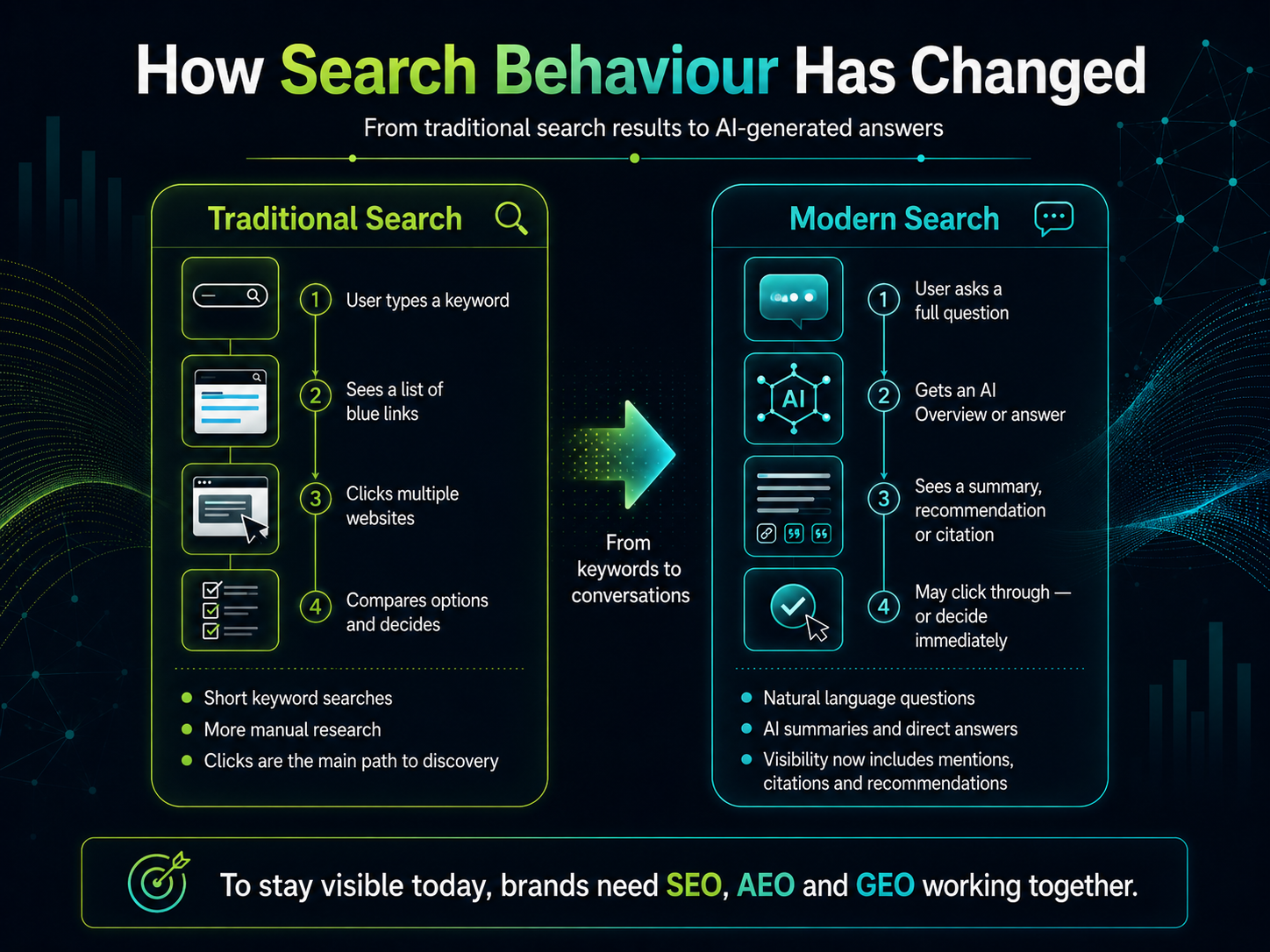
Search used to be short and keyword-led.
People searched things like:
“accountant Preston”
“best running shoes”
“SEO agency Manchester”
“mobility scooter finance”
Now, people are more comfortable asking full questions:
“Who is the best SEO consultant for a small business?”
“What should I check before buying a used mobility scooter?”
“How do I know if my website has a technical SEO problem?”
“What is the difference between SEO, AEO and GEO?”
This matters because the intent is richer.
A short keyword often gives limited context. A full question tells you much more about what the user needs.
AEO and GEO both respond to this change.
AEO helps you answer those specific questions.
GEO helps you become visible when AI tools respond to them.
That means keyword research still matters, but it should be expanded with question research, topic research, customer research and search intent mapping.
You need to understand not only what people type, but what they are trying to achieve.
The Role of Keywords in SEO, AEO and GEO
Keywords are still important, but they are not the whole picture.
In SEO, keywords help identify demand. They show what people are searching for and how often.
In AEO, questions and natural language queries become more important. The goal is to answer the exact thing the user wants to know.
In GEO, topics, entities and context become even more important. AI systems need to understand who you are, what you do, what you are known for and how your content connects to broader topics.
For example, a traditional SEO keyword might be:
“technical SEO consultant”
An AEO version might be:
“What does a technical SEO consultant do?”
A GEO-focused content angle might be:
“How to choose a technical SEO consultant for a complex website migration”
The GEO version is deeper and more contextual. It gives an AI system more useful information to work with. It also reflects how real people use AI tools: they ask for advice, comparisons, recommendations and explanations.
That does not mean every page needs to be a long article. But it does mean your content strategy should cover the questions, comparisons and decision-making points that matter to your audience.
The Role of Content Structure
Content structure is one of the most important parts of SEO, AEO and GEO.
Search engines and AI systems need to understand what your page is about. Users need to scan the page quickly and find what they need.
A well-structured page should have:
One clear H1 heading.
Logical H2 and H3 headings.
Short, focused paragraphs.
Clear definitions.
Useful examples.
Tables where comparisons are needed.
Bullet points where they improve readability.
FAQs for common follow-up questions.
Internal links to relevant pages.
A clear next step.
This is especially important for AEO and GEO because answer engines and generative AI systems often need to extract or summarise information.
If your content is buried in long, vague paragraphs, it is harder to use.
If your page clearly explains a topic, answers related questions and shows expertise, it becomes more useful for both humans and machines.
Good structure does not mean robotic writing.
It means making your expertise easy to understand.
The Role of Structured Data (Schema)
Structured data is code added to a page to help search engines understand the content more clearly.
It can describe things such as articles, FAQs, products, reviews, organisations, local businesses, events and services.
Google explains that structured data helps it understand page content and gather information about the web and the entities included in the markup.
Structured data can support SEO because it helps search engines interpret your content. It can also make some pages eligible for rich results, depending on the type of schema used and Google’s policies.
For AEO, structured data can help clarify questions, answers and page types.
For GEO, structured data can help reinforce entity understanding.
However, structured data is not a magic fix.
Adding schema markup to weak content will not suddenly make that content useful. It should support the page, not compensate for poor quality.
The priority should always be:
Create genuinely useful content first.
Structure it clearly on the page.
Then use structured data to reinforce what the page is about.
The Role of E-E-A-T
E-E-A-T stands for Experience, Expertise, Authoritativeness and Trustworthiness.
It is not a single ranking factor, but it is a useful way to think about content quality.
For SEO, E-E-A-T helps you create content that feels credible and useful.
For AEO, it helps answer engines identify content that deserves to be used as an answer.
For GEO, it becomes even more important because AI systems are often forming summaries from multiple sources. If your content is generic, unsupported or lacks real insight, it is less likely to stand out.
Experience is especially important.
AI tools can produce generic explanations very quickly. What they cannot easily replace is genuine first-hand knowledge.
That means businesses should create content that includes:
Real examples.
Original insight.
Expert commentary.
Specific advice.
First-hand experience.
Clear opinions where appropriate.
Evidence of work done.
Practical explanations rather than generic theory.
For a service-based business, this might include case studies, process explanations, before-and-after examples, client scenarios, common mistakes and honest advice based on real experience.
The more specific your content is, the more valuable it becomes.
How SEO, AEO and GEO Work Together
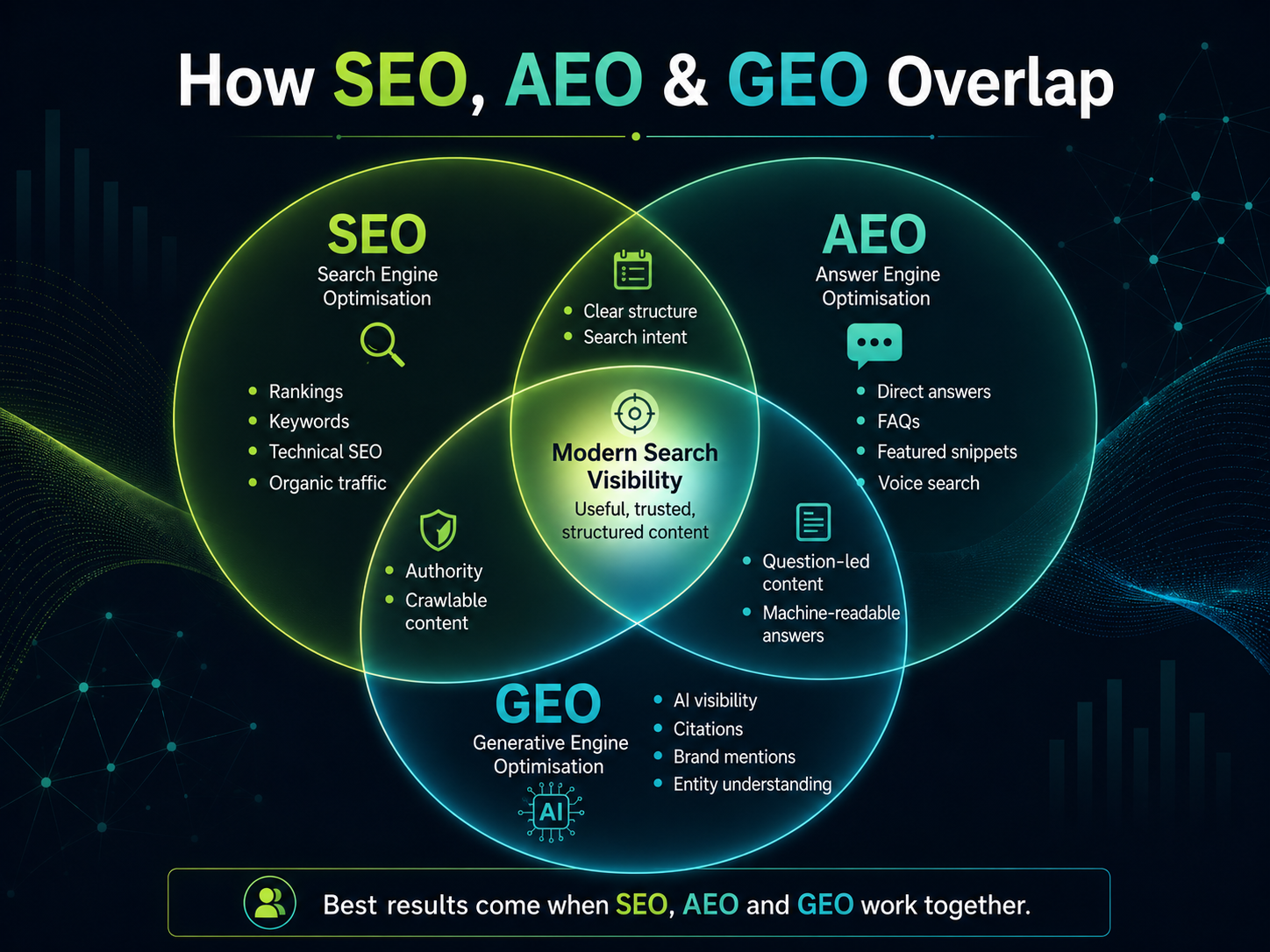
The strongest approach is not to choose between SEO, AEO and GEO.
It is to build a strategy where all three support each other.
For example, imagine you are creating a page about technical SEO audits.
The SEO layer would focus on:
Target keywords.
Page title and meta description.
Crawlability and indexation.
Internal linking.
Page speed.
Search intent.
Content depth.
The AEO layer would focus on:
“What is a technical SEO audit?”
“What does a technical SEO audit include?”
“How long does a technical SEO audit take?”
“How much does a technical SEO audit cost?”
“When does a website need a technical SEO audit?”
The GEO layer would focus on:
Clear expert explanations.
Comparison content.
Original insights from real audits.
Strong author and business information.
Consistent service positioning.
Useful content that AI systems can summarise.
Mentions and authority beyond your own website.
Together, these layers create a much stronger page.
It can rank in Google. It can answer common questions. It can support AI visibility.
That is the future of organic search.
Practical Example: SEO vs AEO vs GEO in Action
Let’s use the topic “AEO consultant” as an example.
A traditional SEO approach might create a service page targeting:
AEO consultant
AEO expert
Answer engine optimisation consultant
AEO services
The page would explain the service, include benefits, target keywords and encourage enquiries.
An AEO approach would add direct answers to questions such as:
What is an AEO consultant?
What does an AEO consultant do?
Is AEO different from SEO?
How does AEO help a business?
Do I need AEO if I already have SEO?
A GEO approach would go further by strengthening the brand and topic association.
That could include:
A detailed guide explaining AEO.
A comparison article on AEO vs SEO vs GEO.
Case studies showing how content was improved for AI search visibility.
A clear author profile showing relevant experience.
Mentions on other reputable websites.
Consistent messaging across the website.
Pages that explain how AEO fits into wider SEO strategy.
The result is a stronger digital footprint.
You are not relying on one page to do all the work. You are building a cluster of content and authority around the topic.
That is much more likely to perform across traditional search, answer engines and AI search.
What Businesses Should Do Now
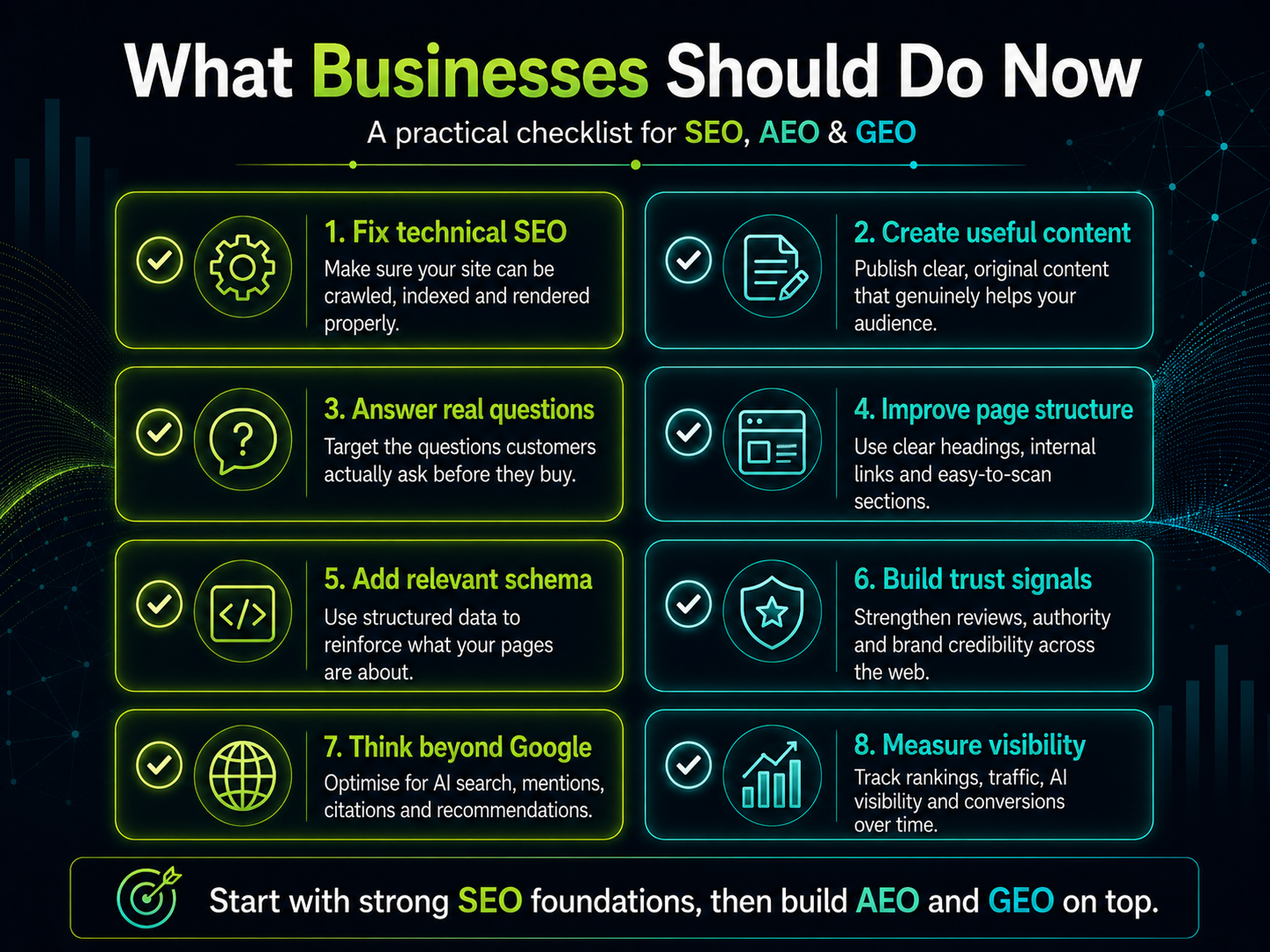
Businesses do not need to panic or completely rebuild their SEO strategy overnight.
But they do need to adapt.
The first step is to stop thinking only in terms of rankings.
Rankings are still important, but they are only one part of visibility.
You also need to consider:
Is my content answering real customer questions?
Is my business clearly associated with the topics I want to be known for?
Can search engines understand who I am and what I offer?
Does my content show real expertise?
Would an AI tool have a reason to mention my business?
Is my website technically sound?
Do I have clear service pages and supporting articles?
Is my content better than generic AI-written content?
If the answer to those questions is no, then there is work to do.
A modern organic search strategy should include:
Technical SEO to make sure the website can be crawled and indexed.
Content strategy to cover important topics and questions.
On-page SEO to make pages clear and relevant.
AEO improvements to answer common questions directly.
GEO improvements to build authority, trust and AI visibility.
Digital PR and brand mentions to strengthen credibility.
Ongoing measurement to understand what is changing.
The businesses that win will be the ones that invest in clarity, usefulness and authority.
Not Sure How Visible Your Business Is Across Google and AI Search?
I can review your current SEO, AEO and GEO position and identify what needs improving.
Request an SEO & AI Search ReviewHow to Optimise for SEO
To improve SEO, start with the foundations.
Your website should be technically healthy. Search engines need to crawl, render and index your pages properly. Important pages should not be blocked, duplicated, broken or buried too deeply within the site.
Your pages should also target the right search intent.
Search intent means understanding what the user wants when they search.
Are they looking for information?
Are they comparing options?
Are they ready to buy?
Are they looking for a local provider?
A page targeting a commercial keyword should not read like a basic blog post. A page targeting an informational query should not be too sales-heavy.
Good SEO includes:
Keyword research.
Technical audits.
Metadata optimisation.
Content optimisation.
Internal linking.
Image optimisation.
Page speed improvements.
Mobile usability.
Local SEO where relevant.
Authority building.
Ongoing performance tracking.
The aim is to create pages that search engines can understand and users genuinely find useful.
How to Optimise for AEO
To improve AEO, focus on answering questions clearly.
Start by identifying the questions your customers ask before they buy, enquire or make a decision.
These questions might come from:
Google’s People Also Ask results.
Search Console queries.
Sales calls.
Customer emails.
Live chat messages.
Competitor content.
AI tools.
Keyword research platforms.
Your own experience.
Once you have those questions, create content that answers them directly.
A strong AEO answer should be:
Clear.
Accurate.
Concise.
Easy to extract.
Supported by detail.
Written in natural language.
For example, if the question is “What is AEO?”, do not start with three paragraphs of background.
Answer it directly:
AEO, or Answer Engine Optimisation, is the process of structuring website content so it can be used to answer specific questions in search engines, AI tools and answer-based search features.
Then expand with more detail.
This structure helps users and search engines.
AEO is not about making content shorter. It is about making the answer easier to find.
How to Optimise for GEO
To improve GEO, focus on becoming a trusted source within your topic area.
Generative AI tools need to understand what your business is, what you offer and why your content should be trusted.
That means your website should clearly explain:
Who you are.
What you do.
Who you help.
Where you operate.
What makes you qualified.
What topics you are knowledgeable about.
What problems you solve.
What experience you have.
Your content should go beyond basic definitions. It should include insight, examples, opinions and practical advice.
GEO-focused content often works well when it covers:
Comparisons.
Decision guides.
Common mistakes.
Industry explainers.
Original research.
Service breakdowns.
FAQs.
Expert commentary.
Case studies.
Process guides.
You should also build authority beyond your own website.
That might include mentions in relevant publications, client reviews, business profiles, podcasts, interviews, case studies, guest contributions and trusted directories.
AI visibility is not only about your website. It is about your wider online footprint.
If multiple trusted sources associate your business with a topic, that can strengthen your chances of being recognised.
What Not to Do
As AEO and GEO become more popular, there will be a lot of bad advice.
Some businesses will be told they need to create hundreds of AI-generated pages. Others will be sold shortcuts that promise to “rank in ChatGPT” or “guarantee AI mentions”.
Be careful.
There are no simple guarantees.
AI search visibility is influenced by many factors, including content quality, technical accessibility, authority, relevance, freshness, brand signals and the way different AI systems retrieve information.
Avoid:
Publishing thin AI-generated content at scale.
Creating pages that add no original value.
Stuffing pages with questions and answers.
Adding schema markup that does not match the visible content.
Chasing every new acronym without fixing the basics.
Ignoring technical SEO.
Assuming AI tools will find your content if search engines cannot.
Treating GEO as a quick hack.
The best approach is still to create useful, trustworthy, well-structured content and make sure your website can be properly discovered and understood.
How to Measure SEO, AEO and GEO
Measurement is one of the hardest parts of modern search.
SEO measurement is the most established. You can track rankings, organic traffic, impressions, clicks, conversions, backlinks, technical health and engagement.
AEO measurement is more difficult, but you can still monitor visibility in featured snippets, People Also Ask results, FAQ-style searches and question-led rankings.
GEO measurement is still developing.
You may need to manually test AI platforms, monitor referral traffic from AI tools, track brand mentions, review Search Console changes and use specialist AI visibility tools as they become more reliable.
Useful things to monitor include:
Organic rankings.
Organic traffic.
Search Console impressions and clicks.
Featured snippet visibility.
People Also Ask appearances.
AI Overview presence.
Referral traffic from AI platforms.
Branded search growth.
Mentions in AI-generated responses.
Conversions from organic traffic.
Visibility for question-led searches.
The key is to avoid relying on one metric.
A drop in clicks does not always mean a drop in visibility. An increase in impressions may indicate your content is appearing in more search experiences. A brand mention in an AI answer may influence a customer even if it does not create an immediate website visit.
Search measurement needs to become more rounded.
Does Every Business Need AEO and GEO?
Most businesses need to at least understand AEO and GEO.
Whether they need a dedicated strategy depends on their market, audience and goals.
A local trades business may still get most enquiries from traditional Google searches and local map results. For that business, local SEO may remain the priority, with AEO-style FAQs added to support common questions.
A professional services firm may benefit heavily from AEO because clients often research complex topics before making contact.
A SaaS business, ecommerce brand or national service provider may need to think more seriously about GEO because users may ask AI tools for recommendations, comparisons and buying advice.
The more your customers research before buying, the more important AEO and GEO become.
If your customers ask questions, compare options or seek advice, you should be thinking about answer and AI visibility.
Is SEO Still Worth Investing In?
Yes.
SEO is still worth investing in because it underpins AEO and GEO.
Your website still needs to be discoverable. Your content still needs to be understood. Your pages still need to be useful. Your brand still needs authority.
Google has stated that its generative AI search features rely on its core Search ranking and quality systems, which means SEO best practices continue to matter.
The difference is that SEO should no longer be treated as just keyword rankings and traffic.
Modern SEO should include:
Technical SEO.
Content quality.
User intent.
Brand authority.
Answer optimisation.
AI search visibility.
Conversion quality.
Topical expertise.
That is a broader and more valuable view of SEO.
Businesses that stop investing in SEO because AI is changing search are likely to fall behind.
Businesses that evolve their SEO strategy to include AEO and GEO will be in a much better position.
Final Thoughts: SEO Is the Foundation, AEO and GEO Are the Evolution
SEO, AEO and GEO are not competing strategies.
They are connected layers of modern search visibility.
SEO helps your website appear in search engines.
AEO helps your content answer specific questions.
GEO helps your brand and content appear in AI-generated answers.
The businesses most likely to benefit from this shift are the ones that build strong foundations now.
That means technically sound websites, useful content, clear expertise, structured answers, trusted brand signals and a willingness to adapt as search behaviour changes.
The goal is no longer just to rank.
The goal is to be found, understood, trusted and chosen — whether the user is searching on Google, asking an AI assistant, reading an answer box or comparing options through a generative search experience.
Search has changed, but the principle remains the same:
Be the most useful answer for the right audience.
That is where SEO, AEO and GEO come together.
Not Sure How Visible Your Business Is Across Google and AI Search?
I can review your current SEO, AEO and GEO position and identify what needs improving.
Request an SEO & AI Search ReviewNeed Help With SEO, AEO or GEO?
If you want to understand how visible your business is across traditional search and AI-driven search, Natural Ranks can help.
I work with businesses to improve technical SEO, content strategy, search visibility and AI search readiness.
Whether you need a full SEO audit, help improving your content, or a clearer strategy for AEO and GEO, I can identify where you are now and what needs to improve next.
Not Sure How Visible Your Business Is Across Google and AI Search?
I can review your current SEO, AEO and GEO position and identify what needs improving.
Request an SEO & AI Search Review