Search visibility is changing.
For years, businesses have judged online visibility by looking at Google rankings, organic traffic, clicks and enquiries. That still matters. Traditional SEO is not going away.
But the way people find information is changing quickly.
Instead of only typing short keywords into Google, people are now asking full questions in tools such as ChatGPT, Google AI Overviews, Gemini, Copilot and Perplexity. They are asking for recommendations, comparisons, summaries and advice.
That means your business might influence a potential customer before they ever click through to your website.
Or the opposite could be true.
Your competitors might be appearing in AI-generated answers while your business is missing completely.
That is where an AI visibility audit comes in.
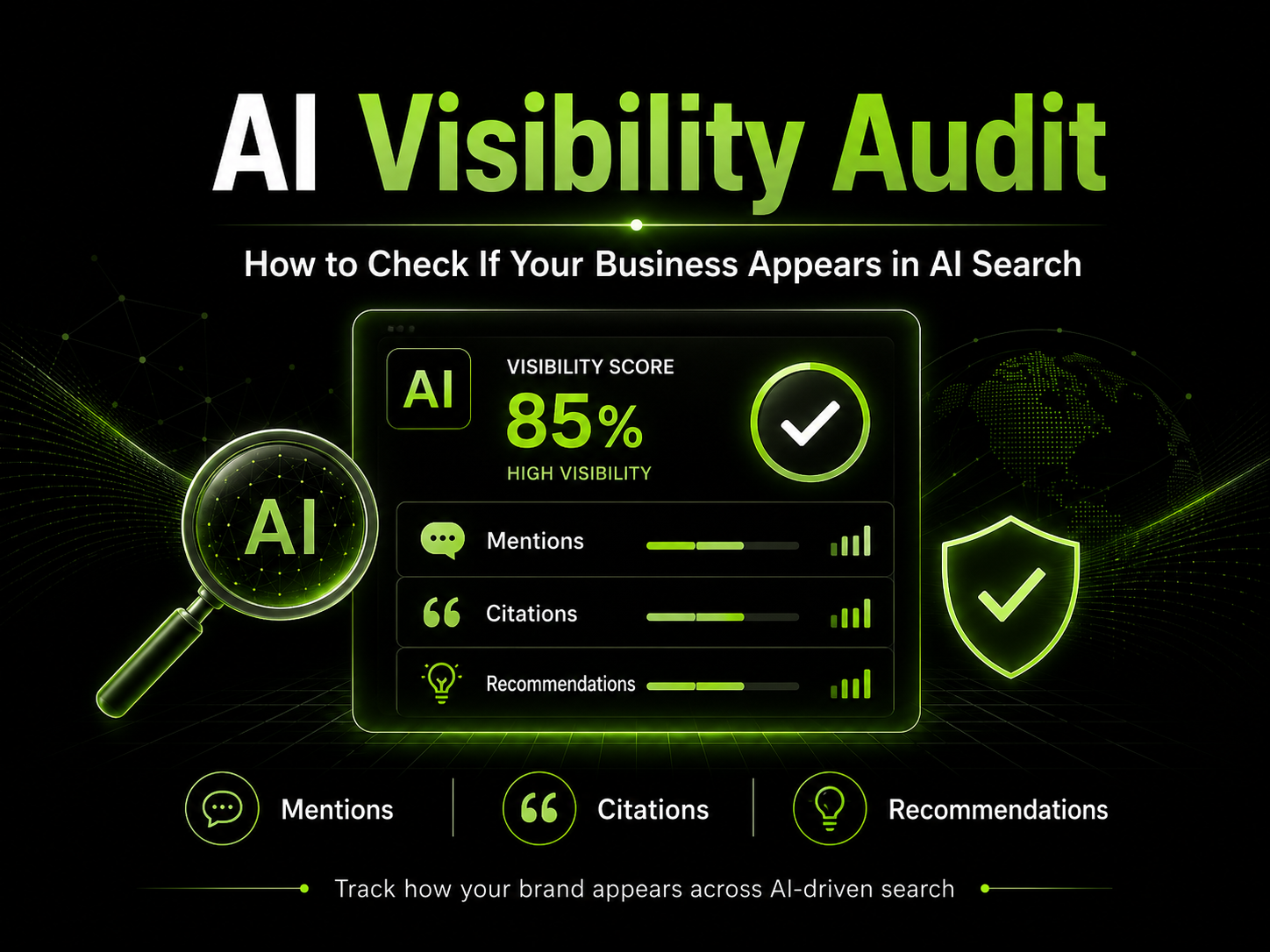
An AI visibility audit helps you understand whether your business appears in AI search results, how accurately your brand is represented, which competitors are being mentioned, and what needs improving to increase your chances of being found, cited and recommended.
This guide explains what an AI visibility audit is, why it matters, how to run one, and what businesses can do to improve their visibility across AI-driven search.
What is AI Visibility?
AI visibility is how visible your business, brand, services, products or content are inside AI-generated search experiences.
In traditional SEO, visibility usually means appearing in Google’s organic search results.
In AI search, visibility can mean:
- your business being mentioned in an AI answer
- your website being cited as a source
- your brand being included in a recommendation
- your content being used to explain a topic
- your competitors appearing when you do not
- your business being described accurately or inaccurately
- your services being understood by AI tools
This is different from simply ranking number one in Google.
AI tools often summarise information from multiple sources. Some may include links and citations. Others may provide answers without sending much traffic back to websites.
Google describes AI Overviews as AI-generated snapshots that provide key information with links to explore more, while OpenAI describes ChatGPT search as providing timely answers with links to relevant web sources.
So the challenge for businesses is no longer just:
“Do I rank?”
It is also:
“Am I being included in the answer?”
That is a big shift.
What Is an AI Visibility Audit?
An AI visibility audit is a structured review of how your business appears across AI search platforms and AI-generated answers.
It looks at whether your business is visible for the types of questions your potential customers are likely to ask.
For example, a user might ask:
- “Who is the best SEO consultant for small businesses in the UK?”
- “Which company can help me appear in AI search?”
- “What should I look for in an SEO audit?”
- “Recommend a technical SEO consultant for a service-based business.”
- “Who are the best local companies for [service]?”
An AI visibility audit checks whether your business appears in those types of results.
It also looks at:
- which competitors appear instead
- whether your website is cited
- whether your brand is described correctly
- what sources AI tools are using
- whether your content answers the right questions
- whether your website is technically accessible
- whether your online authority is strong enough
- whether your business has enough trust signals
The aim is not just to see whether your brand appears.
The aim is to understand why it does or does not appear.
Why AI Visibility Matters
AI search can influence buying decisions earlier than traditional search.
A potential customer might not start by searching for your exact service page. They may ask an AI tool for advice, options or recommendations.
For example:
“What is the best way to improve my website’s visibility in AI search?”
Or:
“Which SEO consultant should I speak to if I want more organic enquiries?”
If an AI tool mentions your business, that can build awareness and trust.
If it mentions a competitor instead, they may get the first opportunity.
This is especially important for businesses where customers do research before making contact. That includes professional services, ecommerce, software, finance, legal, healthcare, home improvement, local services and B2B companies.
AI visibility matters because search is becoming more conversational.
People are not just looking for pages.
They are looking for answers.
They are asking for recommendations.
They are comparing options.
They are expecting a summary before they visit a website.
That means businesses need to think beyond rankings and clicks.
The new question is:
“When AI tools answer questions about my industry, does my business show up?”
AI Visibility vs SEO Rankings
AI visibility and SEO rankings are connected, but they are not the same thing.
SEO rankings usually focus on where a page appears in traditional search results.
AI visibility focuses on whether a brand, page or source appears inside AI-generated answers.
A business could rank well in Google but still be missing from AI-generated recommendations.
Another business could appear in AI answers because it has strong brand mentions, reviews, third-party references, clear content and strong topical authority.
Here is the simple difference:
| SEO Rankings | AI Visibility |
|---|---|
| Tracks positions in search results | Tracks mentions in AI answers |
| Usually keyword-based | Often prompt and question-based |
| Focuses on pages | Focuses on brands, entities, content and sources |
| Clicks are easier to measure | Influence can happen before a click |
| Results are easier to track | AI answers can vary by tool, prompt and timing |
| Mainly focused on search engines | Includes AI assistants and generative search tools |
How to Run a Basic AI Visibility Audit
You do not need expensive software to start checking your AI visibility.
Specialist tools can help, especially at scale, but a basic audit can be done manually.
The important thing is to be structured.
You need to test realistic customer questions, record the results, compare platforms and repeat the process over time.
Here is a practical process.
1. List Your Most Important Services
Start by writing down the services, products or topics you want to be known for.
For Natural Ranks, examples might include:
- SEO consultancy
- technical SEO audits
- AEO services
- GEO services
- AI search visibility
- local SEO
- Google Ads
- SEO for service businesses
- SEO audits for WordPress websites
For another business, the list might include:
- mobility scooters on finance
- septic tank cleaning
- commercial property law
- website design
- damp proofing
- private healthcare services
This gives you the foundation for your AI visibility testing.
You are not checking random prompts.
You are checking the topics that actually matter commercially.
2. Create Realistic Customer Prompts
Next, turn those services into realistic questions a potential customer might ask.
This is where AI visibility differs from traditional SEO.
In SEO, you might track a keyword such as:
“SEO consultant UK”
In AI search, a user might ask:
“Who is the best SEO consultant for a small business in the UK?”
Or:
“What should I look for before hiring an SEO consultant?”
Or:
“Can you recommend someone who can help my business appear in AI search?”
These are more natural, conversational searches.
Useful AI visibility prompts might include:
- “Who are the best [service] providers in [location]?”
- “What companies can help with [problem]?”
- “Which businesses are known for [service]?”
- “What should I look for when choosing a [service provider]?”
- “Compare [your business] with [competitor].”
- “Is [your business] a good company?”
- “Who should I contact for [specific service]?”
- “What are the top companies for [industry/service]?”
The better your prompts reflect real customer behaviour, the more useful the audit will be.
3. Test Across Different AI Search Platforms
Do not rely on one platform.
Different AI tools can produce different answers.
You may appear in one tool and be completely missing from another.
At a basic level, test prompts across platforms such as:
- Google AI Overviews
- ChatGPT search
- Perplexity
- Gemini
- Microsoft Copilot
Record what each platform says.
For each prompt, note:
- whether your business appears
- where it appears in the answer
- whether your website is cited
- which competitors are mentioned
- what sources are used
- whether the answer is accurate
- whether your services are understood properly
The aim is to build a picture of your AI visibility across multiple search experiences.
4. Record Whether Your Business Appears
For each prompt, use a simple scoring system.
For example:
| Result | Meaning |
|---|---|
| Strong visibility | Your business is clearly mentioned or recommended. |
| Partial visibility | Your business appears, but not prominently. |
| Source visibility | Your website is cited, but your brand is not strongly positioned. |
| No visibility | Your business does not appear. |
| Negative or incorrect visibility | Your business appears inaccurately, unfavourably or with outdated information. |
This helps you see patterns quickly.
You might find that your business appears for branded prompts but not for non-branded recommendations.
For example:
“What does Natural Ranks do?”
may produce a decent answer.
But:
“Who can help a UK service business improve AI search visibility?”
may not mention Natural Ranks at all.
That second type of query is often more commercially valuable.
It is where potential new customers are still choosing who to trust.
5. Record Which Competitors Appear Instead
This is one of the most useful parts of an AI visibility audit.
If your business does not appear, who does?
Make a list of the competitors, directories, publishers or websites that are being mentioned.
Then look for patterns.
Are the same competitors appearing again and again?
Are AI tools citing industry publications?
Are review websites being used?
Are comparison pages influencing the answer?
Are list-style articles appearing?
Are local directories contributing to the result?
Are competitor pages clearer, more detailed or more trusted than yours?
This gives you clues about what AI systems may be relying on.
It also shows where your online presence may be weaker than competitors
6. Check Whether Your Website Is Cited
Being mentioned is useful.
Being cited can be even better.
A citation means the AI tool is using your website or content as a visible source.
This can help users verify the answer and may send referral traffic.
When checking citations, look at:
- whether your homepage is cited
- whether a specific service page is cited
- whether a blog article is cited
- whether a third-party profile is cited instead
- whether old or outdated pages are being used
- whether competitor content is being used to answer questions about your market
If your site is never cited, ask why.
It may be because your content is too thin, poorly structured, not crawlable, lacking authority, or not answering the questions people ask.
7. Review How Accurately Your Business Is Described
AI visibility is not always positive.
Sometimes a business appears, but the description is vague, incomplete or wrong.
That can be a problem.
For example, an AI tool might:
- describe old services you no longer offer
- miss important services
- confuse your business with another company
- use outdated location information
- understate your expertise
- fail to mention your specialisms
- describe you too generically
- cite a weak third-party source instead of your own website
This is why brand clarity matters.
Your own website should clearly explain:
- who you are
- what you do
- who you help
- where you operate
- what services you provide
- what makes you qualified
- what problems you solve
- what proof you can show
If your own website does not explain this clearly, AI tools are more likely to misunderstand or overlook you.
8. Look at the Sources AI Tools Are Using
AI search visibility is often influenced by more than your website.
AI tools may use information from:
- your own website
- Google Business Profile
- review platforms
- industry directories
- news articles
- social profiles
- YouTube
- podcasts
- comparison articles
- third-party mentions
- trusted publications
This means AI visibility is partly about your wider digital footprint.
A strong website is essential, but it may not be enough on its own.
If AI tools are repeatedly using third-party sources in your industry, you need to understand which sources matter.
For example, if AI tools recommend businesses based on review sites, then your reviews and profiles become important.
If they cite list articles, comparison pages or industry guides, you may need stronger digital PR or expert-led content.
If they rely heavily on your own website, then your service pages and blog content need to be clear, structured and useful.
9. Identify Content Gaps
Once you have tested prompts and reviewed the results, you can start identifying content gaps.
A content gap is a question, topic or search intent that your website does not currently cover properly.
For example, potential customers might ask:
- “How much does an AI visibility audit cost?”
- “How do I know if my business appears in ChatGPT?”
- “Can SEO help with AI Overviews?”
- “What is the difference between AI visibility and SEO?”
- “How can a small business get mentioned in AI search?”
If your website does not answer these questions, there is less reason for an AI tool to use your content.
The goal is not to create hundreds of low-quality AI-generated pages.
The goal is to create useful, specific, expert-led content that answers real questions.
Good content for AI visibility often includes:
- clear definitions
- comparison guides
- practical checklists
- FAQs
- expert commentary
- original examples
- service explanations
- case studies
- decision-making guides
- common mistakes
The more clearly your content answers real buying-stage questions, the more useful it becomes for both users and AI systems.
10. Repeat the Audit Over Time
AI visibility is not fixed.
Results can change depending on the platform, prompt wording, freshness of sources, location, personalisation and updates to the AI system.
That means a one-off test is useful, but it is not enough.
You should repeat the audit regularly.
For example:
- monthly for important commercial prompts
- quarterly for broader topic visibility
- before and after major content changes
- after improving service pages
- after gaining reviews or third-party mentions
- after publishing important guides or resources
The aim is to track direction over time.
Are you appearing more often?
Are competitors appearing less often?
Are your citations improving?
Is your brand being described more accurately?
Are AI tools connecting your business with the right services?
That is the real value of an AI visibility audit.
What Happens After an AI Visibility Audit?
Once you have completed the audit, the next step is to understand what the results are telling you.
The audit should show whether your business is being mentioned, cited or recommended across AI search tools. It should also show where competitors are appearing instead, which sources are influencing the answers, and whether your business is being described accurately.
If your business is not appearing, that does not always mean something is “wrong”. It may simply mean AI platforms do not yet have enough clear, trusted or consistent information to understand why your business should be included.
Common issues found during an AI visibility audit include:
- weak or unclear service pages
- limited supporting content
- poor technical SEO
- few third-party mentions
- inconsistent business information
- limited reviews or trust signals
- content that does not answer real customer questions
- competitors with stronger authority signals
The audit shows where you are now.
The next stage is deciding what needs to improve so your business becomes easier for AI search platforms to find, understand, trust and recommend.
AI Visibility Audit Checklist
A useful AI visibility audit should answer these questions:
- Does your business appear for important customer prompts?
- Which AI platforms mention your business?
- Is your business visible for non-branded searches?
- Which competitors are being recommended instead?
- Is your website cited as a source?
- Are the cited pages relevant and up to date?
- Is your business being described accurately?
- Are your services clearly understood?
- Are your key pages crawlable and indexable?
- Do your service pages answer the right questions?
- Does your website have useful supporting content?
- Are your reviews and trust signals strong enough?
- Is your business information consistent across the web?
- Are third-party sources supporting your authority?
- Are you tracking changes over time?
If the answer to several of these questions is no, there is likely room to improve your AI search visibility.
How Often Should You Run an AI Visibility Audit?
AI visibility should not be checked once and forgotten about.
AI-generated answers can change over time. Different platforms may use different sources, update their systems, interpret prompts differently or surface different competitors.
For most businesses, a simple AI visibility audit every few months is a sensible starting point.
For businesses in competitive sectors, or those actively investing in SEO, AEO or GEO, it may be worth checking key prompts monthly.
You should also repeat an audit after making important changes, such as:
- publishing new service pages
- improving existing content
- adding FAQs or structured data
- gaining new reviews
- earning third-party mentions
- launching a new service
- changing your business positioning
- improving technical SEO issues
The goal is not to obsess over every individual AI answer.
The goal is to spot patterns.
If your business is appearing more often, being cited more clearly and being described more accurately, your visibility is likely moving in the right direction.
Final Thoughts
AI search is changing how people discover, compare and choose businesses.
Traditional SEO is still important, but it is no longer the full picture.
Your business now needs to be visible across search results, answer engines and AI-generated responses.
An AI visibility audit helps you understand where you stand.
It shows whether your business is being mentioned, cited or recommended. It highlights which competitors are appearing instead. It reveals whether your brand is being described accurately and whether your content is giving AI platforms enough useful information to work with.
The aim is not to chase every new AI trend.
The aim is to make your business easier to find, understand, trust and choose.
That starts with strong SEO foundations, clear content, useful answers and consistent brand signals.
Search is becoming more conversational.
The businesses that win will be the ones that become the clearest and most trusted answer.
Need an AI Visibility Audit?
Not sure whether your business appears in ChatGPT, Google AI Overviews, Perplexity or other AI search tools?
Request an AI Visibility Audit